30N30P
Multi-element high-lift airfoil.
A demanding three-element high-lift benchmark meshed with RobustMesh and exported directly to OpenFOAM for a k–ω SST RANS simulation.
01 / 30N30P geometry
This study considers the 30N30P airfoil in its extended high-lift configuration at an angle of attack of 0°. All dimensions are normalised by a reference chord cref = 1 m, defined for the airfoil in its retracted configuration.
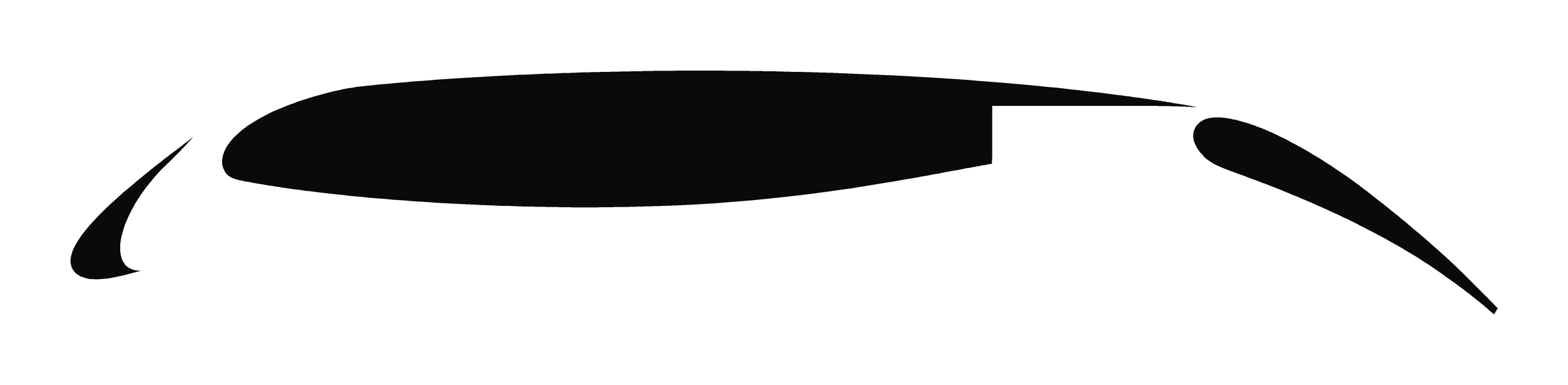
02 / Mesh composition and spatial resolution
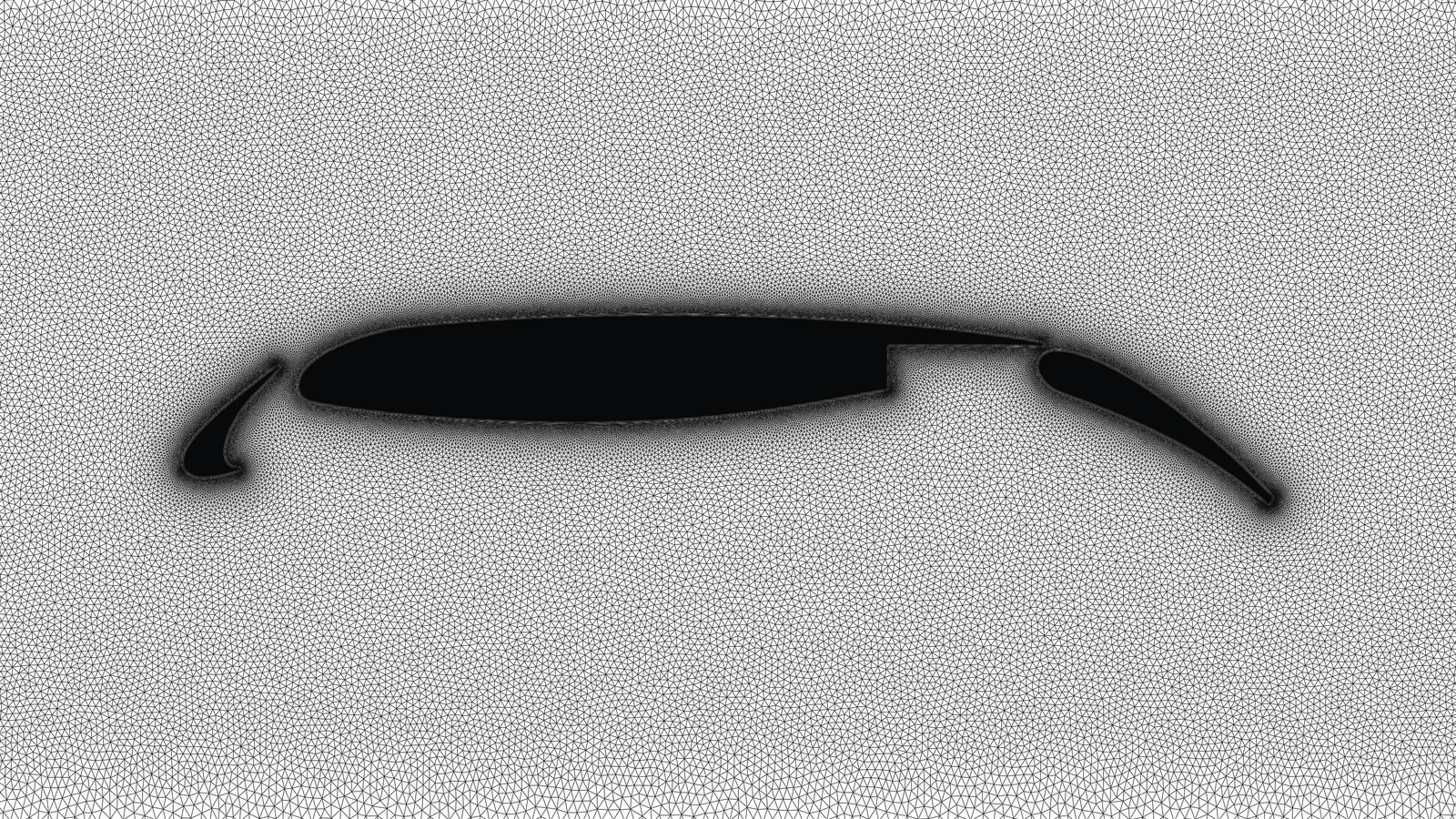
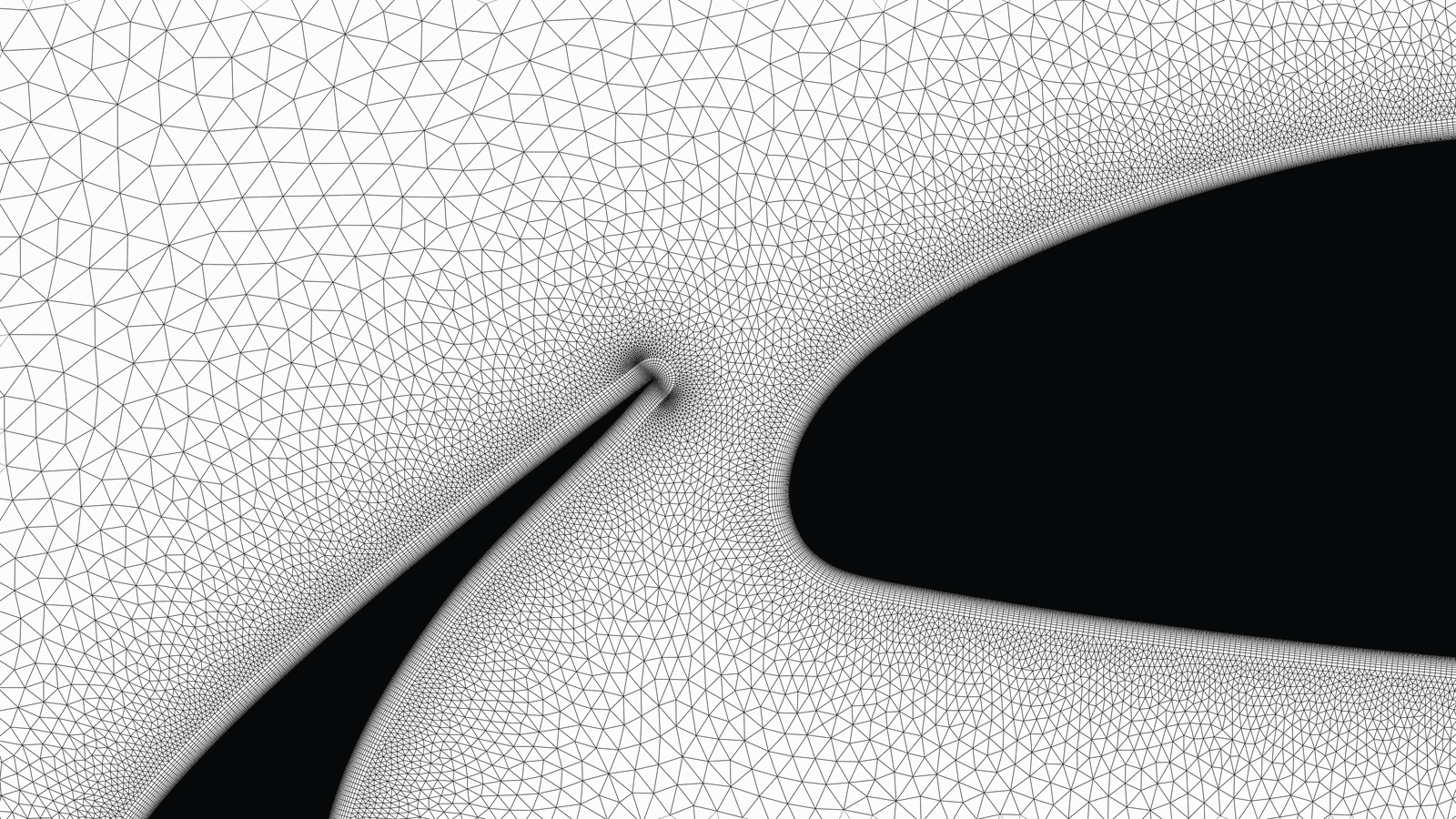
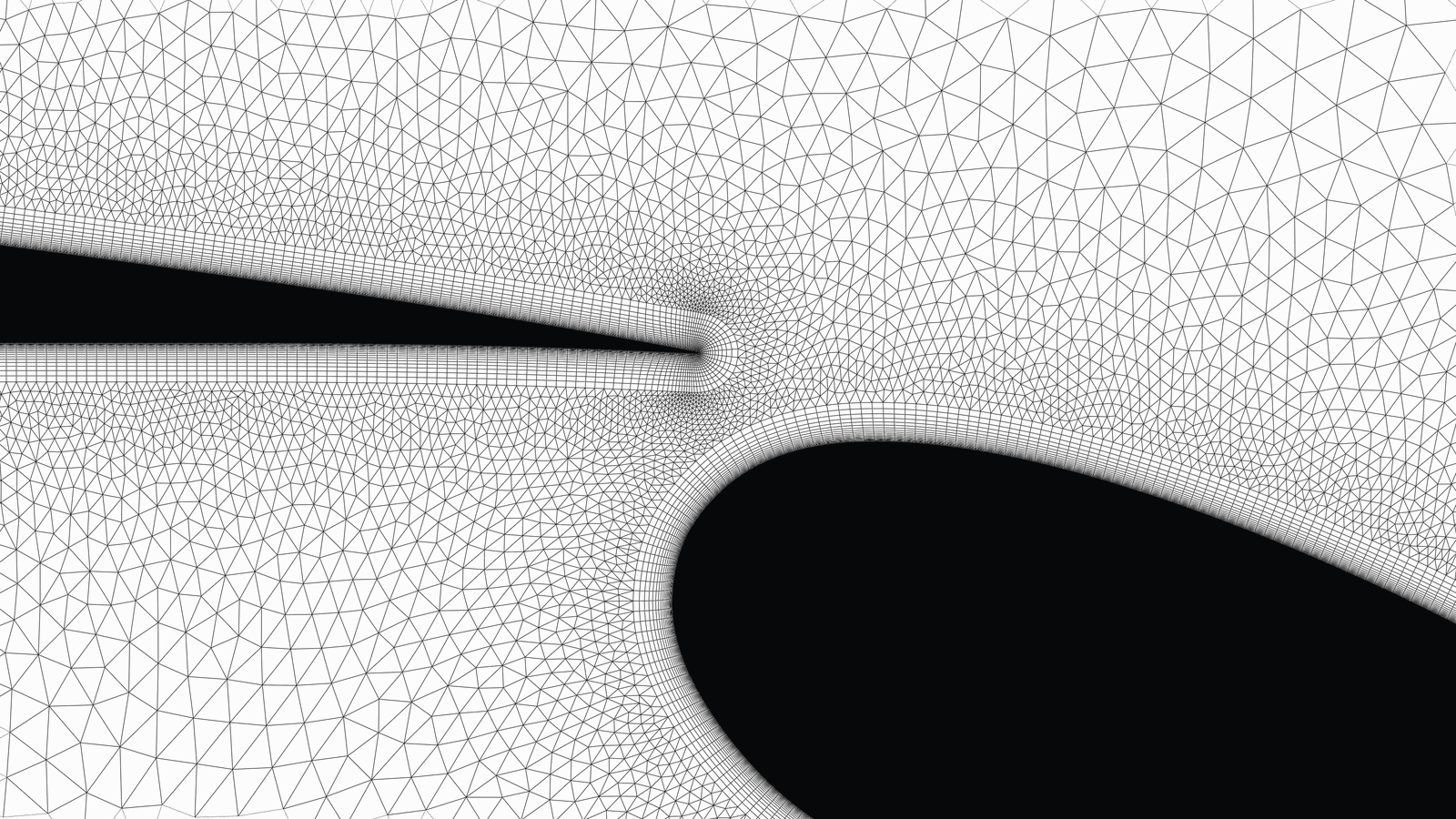
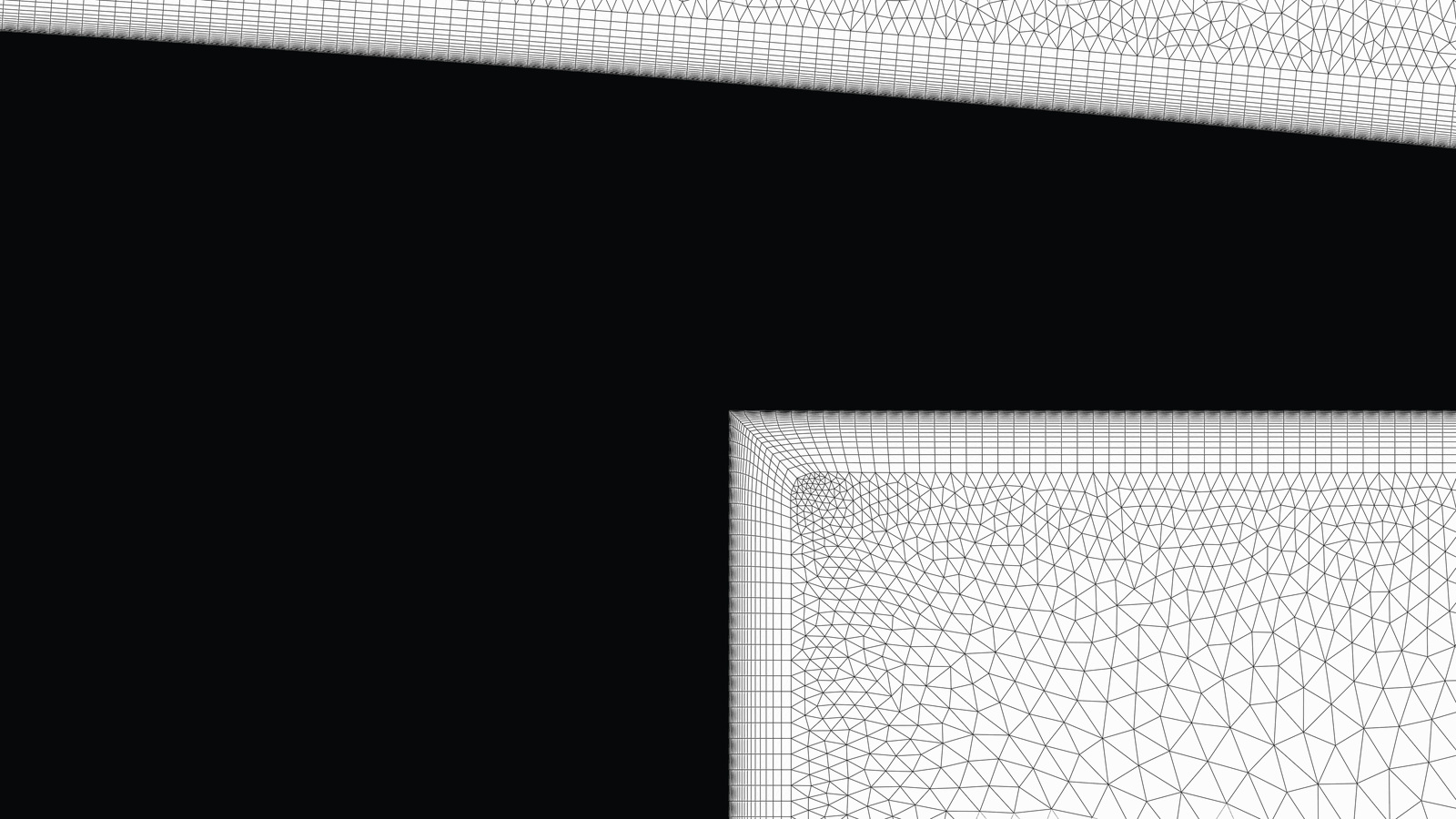
The final mesh combines three nested refinement zones with 30 prismatic layers along the slat, main element and flap. The first prismatic cell is 5 × 10⁻⁶ m thick and the layers use an expansion ratio of 1.18, targeting y+ ~ 1. The rest of the domain is discretised with a graded triangular core.
Prismatic cells · 30 layers over the three-element geometry
Triangular cells · graded from the near field to the prismatic cells
Total cells
Three nested refinement zones

- X extent
- −0.5 → 1.5
- Y extent
- −0.45 → 0.40
- Size (L × H)
- 2.0 m × 0.85 m
- Max mesh size
- 0.010 m
- X extent
- −1.5 → 3.0
- Y extent
- −1.2 → 1.0
- Size (L × H)
- 4.5 m × 2.2 m
- Max mesh size
- 0.030 m
- X extent
- −15 → 30
- Y extent
- −15 → 15
- Size (L × H)
- 45 m × 30 m
- Max mesh size
- 0.700 m
03 / Mesh quality
The cell-quality values and distributions below are taken from the OpenFOAM checkMesh report for the final mesh.
Non-orthogonality
Skewness
Aspect ratio
Face weight
04 / Simulation results
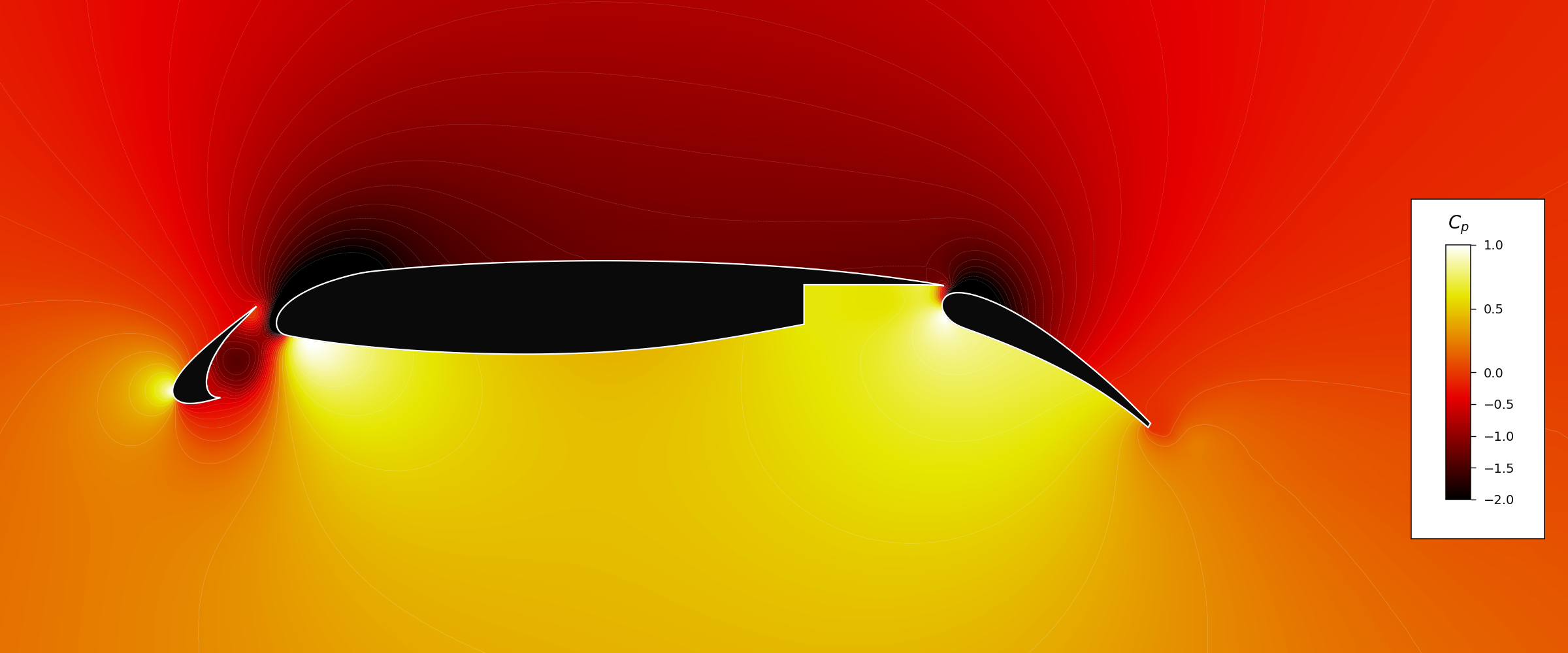
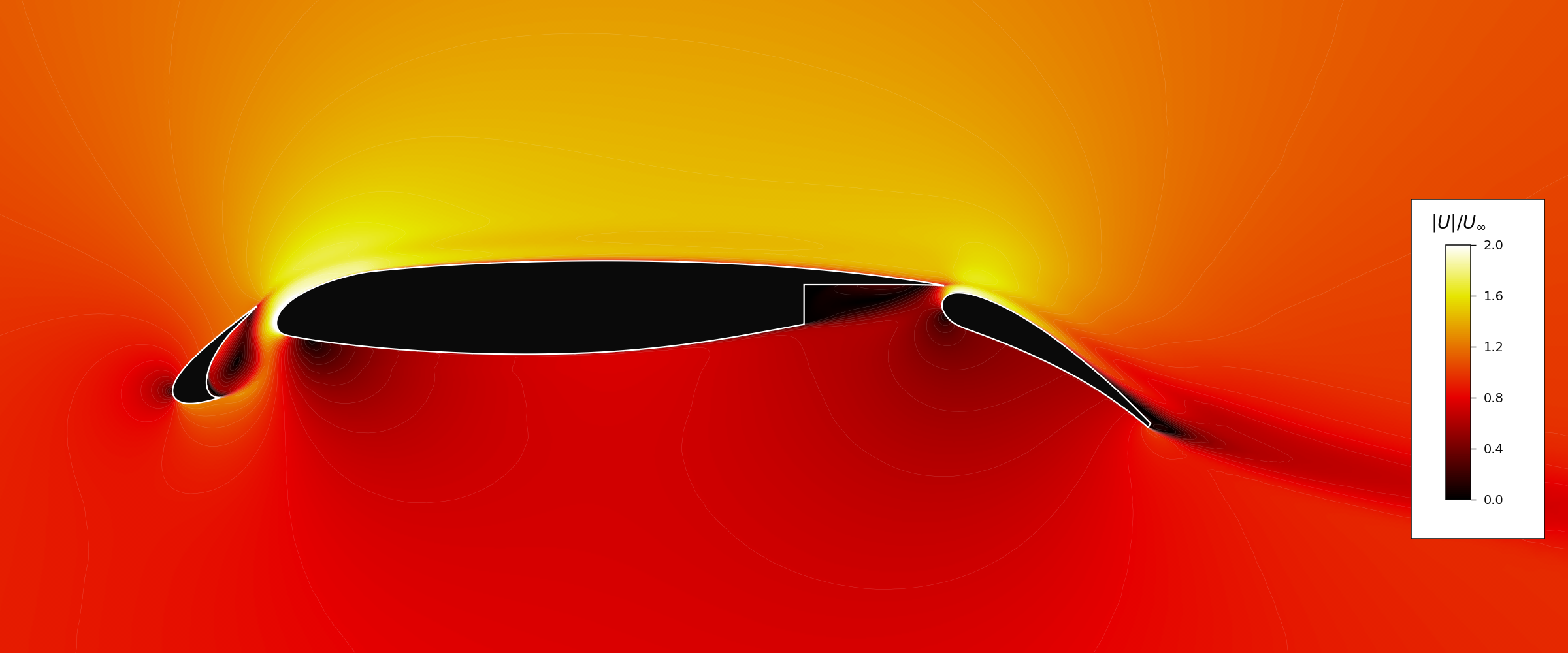
The completed steady k–ω SST RANS calculation at Re = 5 × 10⁶, run with simpleFoam from OpenFOAM v2406 over 2,000 iterations, confirms the near-wall resolution across all three elements.
Convergence and near-wall diagnostics
Solver residuals over 2,000 iterations
y+ distribution at iteration 2,000
U+ vs y+ at iteration 2,000
Pressure and velocity fields
Aerodynamic coefficients
| Coefficient | Experiment | RobustMesh + OpenFOAM 2406 | Percent Error (%) |
|---|---|---|---|
| ClLift coefficient | 2.167¹ | 2.195² | +1.3% |
| CdDrag coefficient | 0.0332¹ | 0.0347² | +4.5% |
05 / Files
All RobustMesh configuration files, the complete OpenFOAM v2406 case, the generated mesh, and the simulation results can be downloaded here.